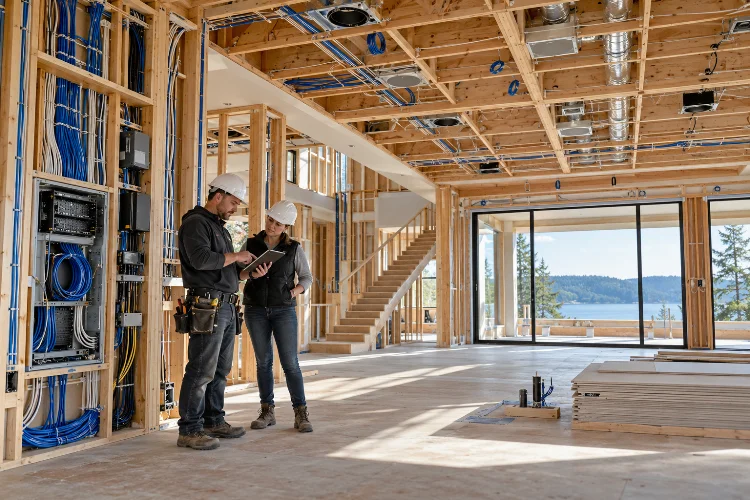
Major renovations create a rare opportunity that most homeowners will not get again for years: the walls are open. That might sound like a small detail, but it changes almost everything when planning a connected home.
Installing network cables, adding electrical circuits, preparing motorized shades, relocating equipment, or creating dedicated technology spaces becomes dramatically easier before plaster, cabinetry, flooring, and ceilings are finished.
Planning smart home infrastructure during major renovation projects is therefore less about choosing the latest smart speaker and more about building a foundation that can support technology for the next decade or longer.
A properly planned system can connect lighting, climate control, security, entertainment, energy monitoring, shades, sensors, and networking without turning the house into a collection of unrelated gadgets.
CEDIA emphasizes that reliable smart-home systems depend on both a strong network and compatible technologies working together as a complete system.
The best time to think about that infrastructure is before the walls close, not after the furniture arrives.
Start With the Smart Home Architecture
Before electricians begin running cables, decide what the finished home is expected to do.
Think beyond individual devices.
Do you want automated lighting throughout the property? Motorized blinds? Whole-home audio? Security cameras? Smart locks? Zoned HVAC? Energy monitoring? EV charging? Leak detection?
Not every feature needs to be installed immediately, but knowing what might eventually be added influences today’s infrastructure decisions.
CEDIA describes integrated smart homes as systems connecting lighting, heating, security, entertainment, and controls through a coordinated network rather than relying on isolated devices.
Create a room-by-room technology plan before construction reaches the electrical stage.
A living room might need network connections, audio wiring, shade power, lighting control, television infrastructure, and occupancy sensing. A utility room may need space for networking equipment, automation controllers, security hardware, and backup power.
Planning everything together prevents expensive surprises later.
Install More Structured Cabling Than You Think You Need
Wireless technology is convenient, but renovation projects should still take advantage of cables wherever they make sense.
Ethernet remains particularly useful for fixed equipment such as wireless access points, cameras, televisions, network controllers, desktop workstations, and automation hubs.
Running additional cable while walls are open is usually far easier than adding it after finishing.
Consider installing Ethernet to ceilings for future wireless access points, exterior locations for cameras, entertainment areas, offices, equipment cabinets, and other places likely to contain permanent connected technology.
Adding conduit can be equally valuable.
Empty conduit provides a pathway for cables that may not even exist yet. Instead of predicting exactly what technology will be popular ten years from now, you create a route through which future wiring can be installed.
Label both ends of every cable and document where unused runs terminate.
A hidden cable is useful only if someone knows it exists.
This basic infrastrucure planning may prove more valuable than buying expensive smart devices during the renovation itself.
Design the Network for the Finished House
A single wireless router is rarely the best networking strategy for a large renovated property.
Building materials affect wireless coverage. Concrete, masonry, metal structures, floor heating systems, mirrors, cabinetry, and multiple levels can all influence where access points need to be placed.
Plan Wi-Fi coverage as part of the architecture.
Ceiling-mounted access points connected through wired Ethernet can provide stronger coverage than trying to push every connection through one router located at the edge of the house.
The network also needs to support increasing numbers of IoT products.
NIST notes that consumer routers have become more significant to household cybersecurity as homes increasingly rely on IoT products and other connected equipment.
Consider where the modem, router, switches, automation controllers, and patch panels will live. Provide adequate ventilation, power outlets, physical access, and space for future expansion.
Hiding everything inside a tiny sealed cabinet may look tidy, but it can make maintenance unnecessarily difficult.
Prepare for Matter and Thread Without Depending on Them Completely
Smart-home standards continue to evolve, which makes flexible infrastructure particularly important.
Matter is designed as an IP-based interoperability standard that allows compatible devices from different brands and ecosystems to communicate more consistently. It can use Wi-Fi, Ethernet, and Thread for connectivity, while Bluetooth Low Energy is used during setup.
Thread fills a different role.
It is a low-power IP-based mesh networking technology designed for smart-home devices such as sensors, locks, lights, and other low-bandwidth equipment. Thread Border Routers connect Thread networks with Ethernet, Wi-Fi, and wider IP networks.
Renovators do not need to wire specifically for every Thread sensor, but they should think about where hubs, border routers, powered smart devices, and networking equipment might be positioned.
The same principle applies to Matter.
Use modern standards to improve compatability, but do not make the home’s physical infrastructure dependent on one ecosystem or manufacturer.
Cables, power, conduit, and suitable equipment locations remain useful even when platforms change.
Plan Power for Devices That May Arrive Later
Connected homes need power in places traditional houses sometimes do not.
Motorized shades may require electrical connections near windows. Video doorbells, cameras, touchscreen controls, sensors, Wi-Fi equipment, smart mirrors, and automated gates can all influence electrical planning.
Think about outdoor areas too.
Future cameras, landscape lighting, irrigation controllers, pool equipment, gates, access systems, and Wi-Fi access points may all require electricity or low-voltage wiring.
Power over Ethernet, commonly called PoE, can simplify certain installations by delivering data and power through one Ethernet cable to compatible equipment.
Even when the final device has not been chosen, planning the likely location can prevent awkward visible cables later.
Also consider backup power.
Routers, switches, security equipment, controllers, and other essential devices may benefit from an uninterruptible power supply so short outages do not immediately take important connected systems offline.
Smart does not automatically mean realiable. Good electrical planning helps close that gap.
Coordinate Lighting, HVAC, Security, and Energy Systems
Renovations are an ideal time to move from individual smart gadgets toward integrated building systems.
Lighting controls can be designed around scenes rather than individual fixtures. HVAC can use occupancy information to reduce unnecessary heating or cooling. Security sensors may contribute to Away routines.
ENERGY STAR’s Smart Home Energy Management Systems framework combines devices such as smart thermostats, lighting, and controllable plug loads through a unified platform. It also recognizes occupancy-based automation and schedules as tools for managing energy consumption.
That type of integration works best when systems are considered before electrical and mechanical work is finalized.
For example, if motorized shades may eventually work alongside cooling automation, power should already be available at the windows.
If a security system will use wired door contacts, installation becomes much easier before door frames and walls are completed.
The goal is not automating everything.
It is making sure the parts that should communicate can do so without expensive retrofitting.
Create a Proper Technology and Equipment Space
Whole-house technology tends to accumulate.
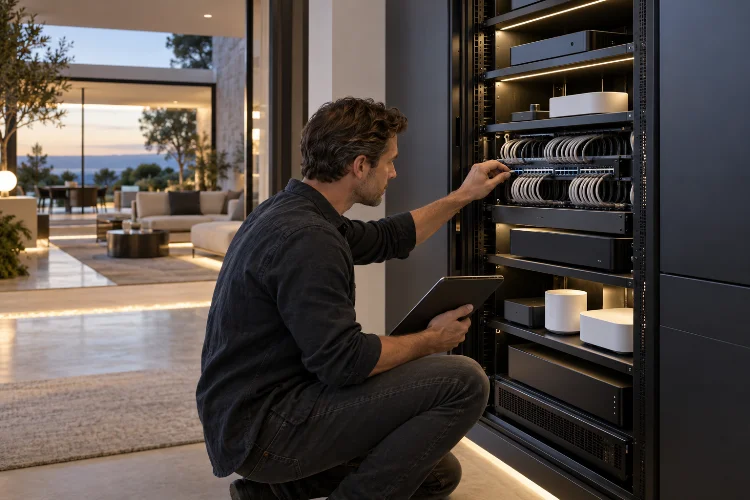
A basic network may eventually include a router, several switches, patch panels, automation hubs, security equipment, audio hardware, video distribution components, storage devices, and backup power.
Give these systems somewhere sensible to live.
A dedicated rack or technology cabinet should have enough physical space for existing equipment plus future additions. Ventilation is important because networking and AV hardware can generate heat.
Provide adequate electrical outlets rather than relying on several consumer extension strips.
Cable management matters too.
Separate power and signal wiring where appropriate, organize patch cables, label connections, and keep documentation nearby.
An orderly technology space makes troubleshooting much easier for both homeowners and future installers.
It also reduces the temptation to scatter hubs and controllers across different rooms simply because there is nowhere else to put them.
Treat Cybersecurity as Building Infrastructure
Cybersecurity should be considered during renovation planning, not added after every device is online.
The router sits at the center of many connected-home communications. NIST’s consumer router guidance emphasizes protecting both user data and the integrity and availability of household networks.
NIST also publishes a broader cybersecurity baseline for consumer IoT products, covering capabilities expected across connected products and their supporting systems.
At a practical level, choose supported networking equipment, keep firmware updated, use strong credentials, and enable appropriate authentication.
More advanced households may also use network segmentation to keep some IoT equipment seperate from computers or other sensitive devices.
Document administrative accounts and system ownership as carefully as physical wiring.
A beautifully integrated connected home becomes difficult to maintain if nobody knows who controls the devices or which accounts were used during installation.
Leave Capacity for Energy Technology
Major renovations increasingly overlap with wider home-energy upgrades.
Solar panels, home batteries, heat pumps, smart electrical panels, EV chargers, and energy-monitoring systems can all become part of the connected-home ecosystem.
Even if these technologies are not included in the current budget, consider their future electrical and networking requirements.
An EV charger may need a substantial electrical circuit and connectivity. Battery storage and solar equipment may require communication with monitoring systems. Smart energy platforms can coordinate thermostats, lighting, plugs, appliances, and other loads.
ENERGY STAR’s smart-home energy framework specifically allows systems to extend beyond thermostats and lighting to technologies such as appliances, EV chargers, and security equipment.
Future-proofing does not mean installing everything today.
It means avoiding renovation decisions that make tomorrow’s upgrades unnecessarily expensive.
Document Everything Before the Walls Close
One of the simplest renovation habits can save enormous frustration later: photograph the walls.
Before plasterboard or other finishes are installed, photograph cable routes, conduits, plumbing, control wiring, electrical boxes, and other hidden infrastructure.
Include measurements from recognizable reference points whenever possible.
Create a digital record showing network outlets, cable labels, electrical circuits, equipment locations, smart-home controllers, and any unused wiring installed for future expansion.
Keep copies of system diagrams and device documentation too.
Years later, someone may want to install a new display, shade motor, security sensor, or automation controller.
Knowing exactly what is hidden behind the finished surfaces can turn an invasive renovation into a relatively simple upgrade.
Planning smart home infrastructure during major renovation projects is primarily about creating options.
Install a strong wired network, plan Wi-Fi coverage properly, provide power and conduit in useful locations, reserve enough equipment space, and consider how lighting, climate, security, energy systems, Matter, and Thread may eventually fit together.
You do not need to install every smart-home feature during construction. The more important goal is making sure the building is ready when those technologies become useful.
Before walls and ceilings are closed, review every room one final time and ask what technology might reasonably be added there over the next decade. A few extra cables, conduits, and electrical provisions today can prevent far more disruptive work tomorrow.