
A modern smart home can easily end up with three separate worlds. The lighting has its own app, the thermostat follows another schedule, and security cameras send notifications through an entirely different platform.
Everything may be “smart,” yet the house still does not behave intelligently as a whole. Integrating lighting climate and security into one smart system changes that approach.
Instead of managing individual technologies independently, homeowners can create routines in which lights, heating and cooling, locks, sensors, cameras, and other devices respond to the same household conditions.
When everyone leaves, unnecessary lights can switch off while the thermostat moves to an energy-saving setting and the security system changes mode.
When someone returns after dark, selected exterior and interior lights can activate while the climate system restores a comfortable temperature.
CEDIA describes integrated smart-home systems as setups that connect technologies such as lighting, heating, security, and entertainment through a unified network.
The real benefit is not having more technology. It is making several systems behave like one home.
Start With Household Scenarios, Not Individual Devices
Before choosing hardware, decide what you want the home to do.
Think in terms of situations such as arriving home, leaving for work, going to sleep, entertaining guests, or taking a vacation. Each scenario can involve several systems at once.
An “Away” scene might switch off most lights, lower heating or cooling demand, and change security settings. A “Goodnight” routine could dim bedroom lighting, adjust the thermostat, confirm selected doors are secured, and turn off unnecessary downstairs equipment.
This approach is more useful than automating devices individually because household routines naturally cross technology categories.
CEDIA emphasizes scenes and schedules as a major advantage of integrated smart-home design rather than relying solely on standalone connected products.
Begin with perhaps four or five routines that genuinely happen every day. Complex automation can always be added later.
Build a Strong Network Before Connecting Everything
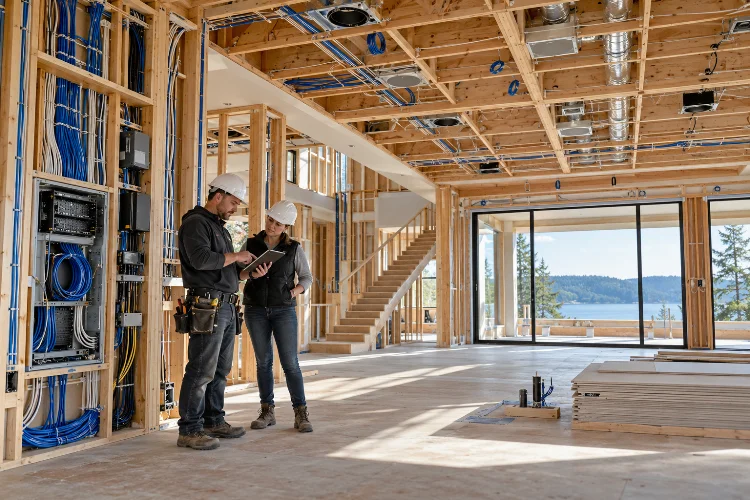
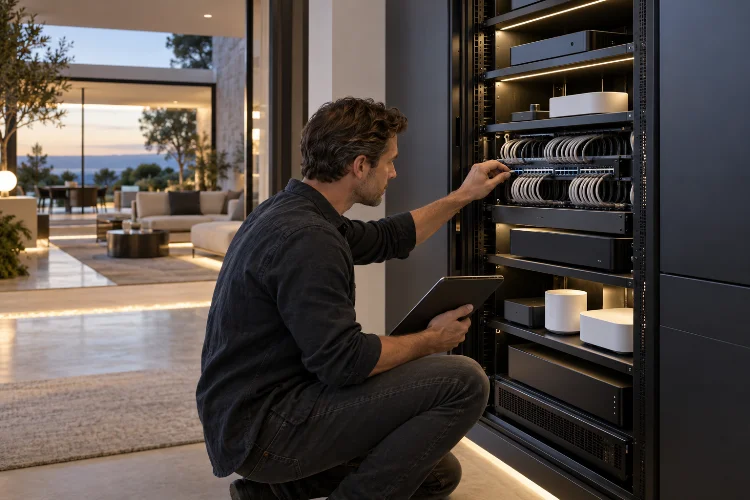
Lighting, thermostats, sensors, cameras, smart locks, hubs, and mobile controls all depend on communications infrastructure.
That makes the home network one of the most important components of the entire system.
Fixed, high-bandwidth devices such as cameras and central controllers may benefit from wired Ethernet where practical. Wi-Fi can handle many other products, while low-power mesh technologies may suit sensors and battery-operated equipment.
Coverage also matters.
A large house with thick walls may require several correctly positioned wireless access points rather than one router hidden in a utility cupboard.
Network security deserves the same attention. NIST notes that routers play an increasingly important role in protecting connected households as smart-home IoT devices become more common.
A beautiful automation system running on an unreliable network will still feel unreliable.
Connect Lighting With Occupancy and Security
Smart lighting becomes far more useful when it understands what is happening elsewhere in the house.
Consider an exterior motion sensor.
Instead of only triggering a camera notification, it could also illuminate the driveway or entrance after dark. Similarly, opening the front door at night might activate a softly lit route toward the main living area.
Lighting can also become part of an Away routine.
Once the house is confirmed empty, unnecessary fixtures can switch off automatically. During extended travel, selected lights might follow carefully designed schedules to support normal household patterns.
ENERGY STAR notes that smart lighting can be scheduled, remotely controlled, and integrated with other connected-home functions.
Avoid making every security event trigger every light.
A cat moving through the backyard should not necessarily illuminate the entire house at 3 a.m. Good automation uses conditions such as time, location, sensor type, and occupancy before deciding what to do.
Let Climate Control Respond to Real Occupancy
Climate automation is another area where integration can provide meaningful benefits.
A thermostat following only a fixed schedule assumes people live perfectly predictable lives. Real households do not.
Someone may work from home unexpectedly, leave earlier than normal, or return from a trip in the afternoon.
Presence information can allow the HVAC system to respond more intelligently. When everyone leaves, temperature settings can move toward an energy-saving range. As household members return, the system can restore comfort.
ENERGY STAR says certified smart thermostats can adjust heating and cooling when residents are asleep or away, while some models support geofencing and learning of temperature preferences.
Heating and cooling also represent a major household energy load. ENERGY STAR reports that, for the average American household, almost half of annual energy spending goes toward heating and cooling.
That makes climate integration more than a convenience feature.
Create Cross-System Automations Carefully
Once lighting, climate, and security share information, more advanced routines become possible.
Imagine a summer afternoon when everyone leaves home.
The security mode changes to Away. Lights turn off. The thermostat relaxes its cooling target. Compatible window shades close on sun-exposed façades to reduce heat gain.
Everything responds to one condition: the house is empty.
But avoid creating huge chains of dependencies.
If one occupancy sensor fails, it should not cause five essential household systems to behave unpredictably. Automation should be modular enough that individual devices can fail without making the whole house unusable.
This is also why manual overrides remain important.
A resident should always be able to operate important lighting and climate functions without understanding the entire automation logic.
The best integrations feel realiable, not clever.
Use Matter to Improve Cross-Brand Integration
One challenge in smart-home design has traditionally been getting products from different manufacturers to communicate.
Matter is designed to improve this situation.
The Connectivity Standards Alliance describes Matter as an IP-based connectivity standard focused on interoperability, reliability, and security across compatible smart-home products.
Its supported categories include lighting and electrical devices, HVAC controls, door locks, safety and security sensors, controllers, and window coverings. Matter can operate over networking technologies including Wi-Fi, Ethernet, and Thread, depending on the device.
This does not mean every smart product automatically works with everything else.
Check certification, device category support, platform capabilities, and which features are exposed through Matter before purchasing equipment.
Good compatability reduces the number of isolated ecosystems homeowners need to maintain.
Use Security Events as Context, Not Just Alarms
Integrated security can provide useful context for the rest of the house.
A door sensor can indicate that someone has arrived. Window sensors might inform climate automation that conditioned air could be escaping. Motion detection can support lighting decisions.
However, security automation requires sensible limits.
A connected lock, alarm, or camera has very different consequences from a decorative smart bulb if something goes wrong. Important security functions should have predictable behavior and appropriate fallback options.
NIST’s consumer IoT cybersecurity baseline identifies security capabilities that should apply across connected products and their supporting components rather than considering individual devices in isolation.
Use strong unique credentials, apply software updates, enable multifactor authentication where supported, and review which users and platforms have access.
Security should never become seperate from the rest of smart-home planning.
Combine Comfort and Energy Management
Integration can also help a home reduce wasted energy without demanding constant attention from residents.
ENERGY STAR’s Smart Home Energy Management Systems framework combines a smart thermostat, lighting, and controllable plug loads as core elements, with security and other connected devices potentially joining the system.
It highlights scheduling, usage-based recommendations, and occupancy-based control as ways smart systems can manage energy.
The important word is manage – not simply minimize.
People still need comfortable temperatures and useful lighting.
An automation that switches lights off while someone is quietly reading will be disabled quickly. The same applies to a thermostat that changes temperature too aggressively.
Start conservatively and adjust routines using real household behavior.
Systems usually become smarter through refinement rather than complicated rules created on installation day.
Keep Important Functions Working During Failures
Ask one important question during system planning: what happens when the internet goes down?
Lighting should still be usable. Heating and cooling should continue functioning safely. Residents should still be able to enter or leave their home.
For example, ENERGY STAR requires certified smart thermostats to retain basic thermostat functionality even when connectivity to the service provider is unavailable.
Local control can therefore be valuable.
Matter is also designed around local IP connectivity for compatible devices, although remote access typically requires an internet-connected home controller or another supported path.
Think of cloud services as an additional layer rather than the only way essential systems work.
The more important a function is, the more carefully its failure state should be designed.
Protect Privacy Across the Integrated System
Integration means more information is potentially shared between devices.
Occupancy sensors reveal movement. Thermostats can indicate when a house is occupied. Cameras capture visual information, while connected locks record access events.
That information makes automation possible, but it also deserves protection.
NIST’s research into consumer smart-home security highlights privacy and cybersecurity concerns around connected household devices and emphasizes the importance of giving users appropriate ways to manage those risks.
Do not collect information simply because a device can.
A basic motion sensor might be enough to control hallway lights without placing a camera indoors. Similarly, local automation may sometimes accomplish a task without continuously sending information to external services.
Review permissions and connected accounts occassionally, especially after adding new household members, platforms, or devices.
Integrating lighting, climate, and security is most valuable when those systems work together around real household behavior rather than simply sharing the same app.
Start with routines such as arriving home, leaving, sleeping, and traveling. Build reliable networking underneath them, choose interoperable equipment, and use occupancy or security information to coordinate lighting and temperature intelligently.
At the same time, preserve manual controls, secure connected devices, and design sensible behavior for network or internet failures.
If you are planning a smart-home upgrade, map your most repetitive household routines before buying hardware.
Then identify where lighting, HVAC, and security can share information to remove unnecessary steps. A genuinely smart system should feel simpler every day – not more complicated.