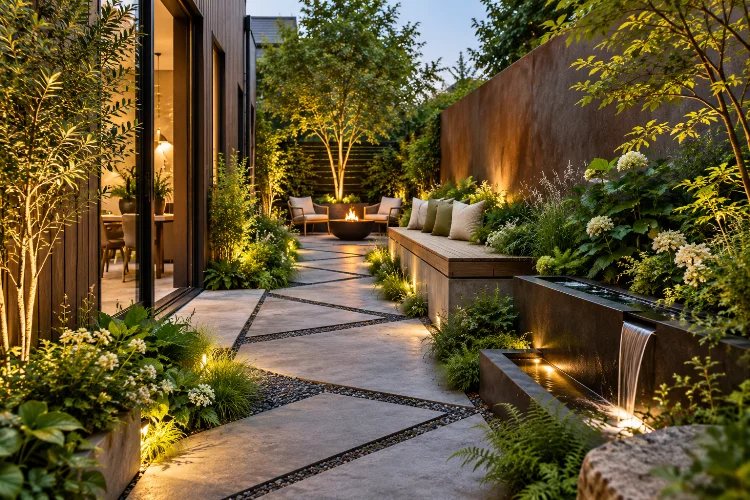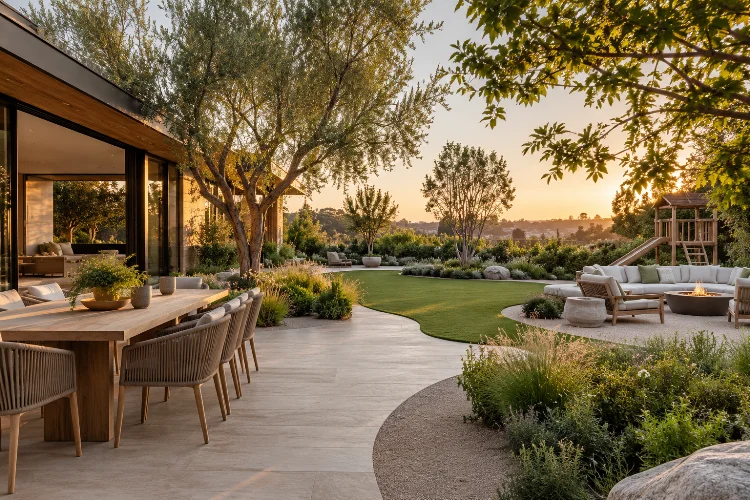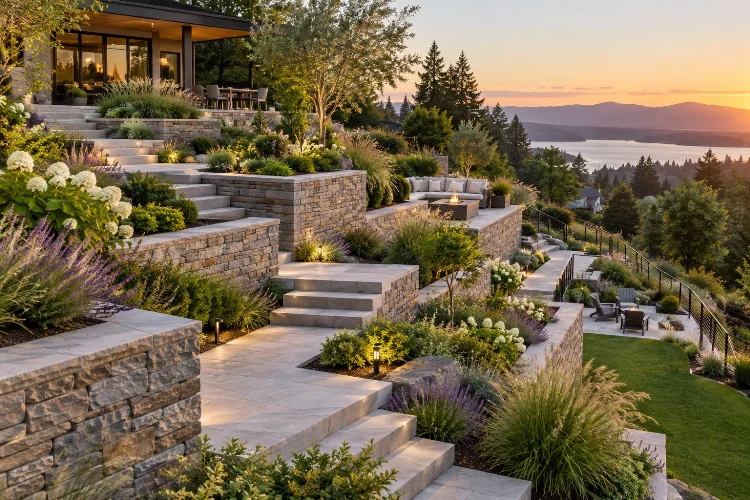
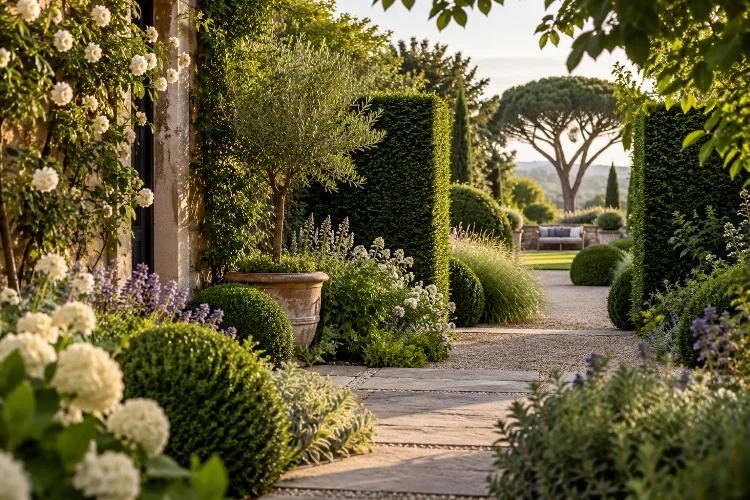
A garden can contain beautiful plants, expensive paving, and carefully selected furniture yet still feel surprisingly flat. The problem is often not what is in the landscape, but how the eye moves through it.
Good garden design creates a sequence of views.
A path might pull your attention toward a specimen tree. An opening between two hedges may reveal a seating area. Taller planting in the foreground can partially hide another section, creating curiosity about what lies beyond.
That is the idea behind designing garden sightlines for stronger depth and visual structure.
Sightlines are deliberate visual routes that guide attention toward focal points, distant scenery, entrances, or other important parts of the landscape. Used carefully, they can make small gardens feel more expansive and large gardens feel more organized.
The goal is not to reveal everything immediately. Strong landscapes balance clear views with partial concealment, creating enough structure to orient visitors while leaving something interesting to discover.
Start With Views From Inside the House
Garden sightlines should not begin at the garden gate.
Start inside the home.
Stand at important windows, doors, kitchen counters, dining tables, and seating areas. These are positions from which residents may view the landscape hundreds of times each year.
Ask what each opening currently frames.
A kitchen window overlooking bins or an empty fence represents an opportunity. A small ornamental tree, sculpture, water feature, or layered planting composition could transform that everyday view.
Framing views from doors and windows can strengthen the connection between indoor and outdoor spaces. Landscape designers also use openings, trellises, planting, and architectural features to direct attention toward selected scenes.
Treat major windows almost like picture frames.
You are not simply landscaping the ground outside them. You are composing what someone sees from the interior.
Establish a Small Number of Strong Focal Points
Every view does not need something dramatic at the end of it.
In fact, too many focal points can make a garden feel visually noisy.
Choose a few features that deserve attention. This might be a sculptural tree, bench, fountain, large container, artwork, pergola, or distinctive planting group.
The RHS describes focal points as tools for guiding the eye and encouraging movement through a garden. They can also redirect attention away from unattractive elements.
Location matters more than cost.
A simple bench positioned precisely at the end of a long path can have more visual impact than an expensive sculpture placed randomly beside a lawn.
Try looking from several directions before fixing the position.
A focal point that works beautifully from the terrace might disappear behind planting when viewed from the kitchen.
Build Depth With Foreground, Middle Ground, and Background
One of the easiest ways to create depth is to borrow a principle used in photography.
Think in three layers.
The foreground contains elements close to the viewer, such as grasses, low shrubs, paving, or the edge of a terrace. The middle ground might contain larger planting groups or a path. The background provides taller trees, structures, boundaries, or distant scenery.
RHS photography guidance specifically notes that gardens gain depth and perspective when views contain distinct foreground, middle-ground, and background elements.
You can use the same principle when designing the real landscape.
For example, ornamental grasses close to a terrace might partially frame a small tree halfway down the garden, while darker evergreen planting creates a backdrop behind it.
The landscape suddenly feels layered rather than flat.
Overlapping elements are particularly effective because the eye interprets one object sitting behind another as perspecitve and distance.
Frame Important Views
A beautiful focal point becomes stronger when something frames it.
Trees, hedges, pergolas, gates, arches, walls, and even tall grasses can create visual borders around selected views.
The RHS recommends framing focal points with features such as doorways, pergolas, or gaps between trees because these structures naturally lead the eye toward the object beyond.
The frame does not need to be perfectly symmetrical.
Two loosely positioned trees may create a softer frame than a formal arch. An opening in a hedge can function almost like a garden window.
Framing is especially valuable in large landscapes where individual features can otherwise feel lost.
Use it selectively.
If every path, tree, and seating area is aggressively framed, the technique loses its impact. Save stronger frames for places where you genuinely want the viewer to stop and look.
Reveal the Garden Gradually
Seeing an entire garden from one position can sometimes make it feel smaller.
Partial concealment creates mystery.
A hedge, screen, tree group, or tall border can prevent visitors from immediately understanding the full dimensions of the property. The suggestion that another area exists beyond creates a stronger sense of depth.
RHS design advice recommends using screens and open spaces to break up views so the whole garden is not visible at once. Layered planting can then reveal different points of interest as someone moves through the space.
This technique works particularly well in long rectangular gardens.
Instead of leaving one uninterrupted view from the house to the rear fence, introduce a partially transparent planting layer about halfway down.
A narrow opening could reveal only a glimpse of a bench or tree beyond it.
That controlled seperation makes the garden feel like a sequence of spaces rather than a single exposed rectangle.
Use Paths to Strengthen Visual Direction
Paths control feet, but they also control eyes.
A straight path creates a strong visual axis and can dramatically emphasize whatever sits at its end.
Curved paths behave differently.
They invite exploration because the destination is not immediately obvious. Planting around the bend can conceal part of the route and increase the feeling that the garden continues beyond what is visible.
The choice should support the overall character of the space.
Formal gardens often benefit from strong axes and symmetry. Informal or naturalistic landscapes may feel better with softer curves and less predictable views.
Edges matter too.
A sweeping border, hedge, line of trees, or repeated planting can guide attention in much the same way as a physical pathway. RHS guidance on garden-planning principles notes that the eye naturally follows lines within the landscape.
Good visual movement and physical circulation usually reinforce each other.
Borrow Good Views Beyond the Boundary
Not every useful garden feature has to belong to you.
A distant tree, hillside, neighboring woodland, church tower, or attractive building can become part of the composition if it is visible from the property.
This approach is commonly known as a borrowed view.
Garden designers use openings in hedges, fences, and planting to capture attractive scenery beyond the site’s physical boundaries.
Instead of installing a tall hedge across an entire boundary, for example, you might screen an unattractive neighboring building while preserving a gap around a beautiful distant tree.
Borrowing views can make a modest garden feel connected to a much larger landscape.
The opposite principle is equally useful.
Screen elements you do not want to see.
The RHS recommends choosing screening according to the required height, growing conditions, and the particular view that needs to be interrupted.
The objective is selective editing rather than simply enclosing everything.
Use Planting Structure to Hold Views Together
Flowers attract attention, but structure creates continunity.
Trees, hedges, evergreen shrubs, grasses, and strong architectural plants help establish visual lines that remain recognizable throughout the year.
Repetition is particularly important.
The RHS notes that repeating plants, forms, or colors adds strength to garden design and prevents a composition from appearing fragmented.
Imagine three small trees appearing at intervals through a long garden.
The repetition creates rhythm and visually connects different areas. Similar effects can come from repeated grasses, clipped shrubs, containers, or paving materials.
Consider mature plant sizes carefully.
A tree planted today to frame a distant view might completely block it ten years later. Gardens change in three dimensions and over time, so sightline planning needs to anticipate growth rather than focusing only on installation day.
Good maintanance should then preserve the original intention without forcing plants into unnatural shapes.
Test Sightlines Before Making Permanent Changes
You can test many visual ideas without planting anything.
Place a chair where a future sculpture might sit. Use temporary stakes to represent trees. Stretch string between posts to simulate the edge of a hedge or screen.
Then walk around.
Look from the kitchen window, terrace, entrance, pathway, and seating areas.
Take photographs from each important position. Images often reveal distracting elements that are surprisingly easy to ignore when standing in the garden.
Also test the design at different heights.
The sightline from a standing adult is different from the view experienced while sitting at an outdoor dining table.
These inexpensive experiments can prevent costly mistakes, particularly when positioning mature trees, permanent structures, walls, and major focal points.
Designing garden sightlines for stronger depth and visual structure is ultimately about controlling what people see, when they see it, and how their attention travels through the landscape.
Strong focal points, layered foregrounds and backgrounds, framed views, paths, selective screening, repeated planting, and borrowed scenery can make gardens feel more intentional and surprisingly larger.
Begin by studying views from both inside and outside the house. Identify what deserves attention, what should be hidden, and which areas could be revealed more gradually.
Before adding more plants or decorative features, improve the visual relationships already present. A carefully positioned tree, opening, path, or bench can sometimes transform the entire garden more effectively than filling every empty space.