A sloped garden can make a simple patio project surprisingly complicated. Put one large terrace near the house and you may need major excavation, tall retaining walls, or an awkward drop at the outer edge.
Put the patio at the bottom of the slope and suddenly every meal involves carrying plates down a long flight of steps.
Multi-level design offers another option.
Designing multi-level patios for sloped residential gardens means turning elevation changes into a sequence of usable outdoor spaces rather than trying to flatten the entire property.
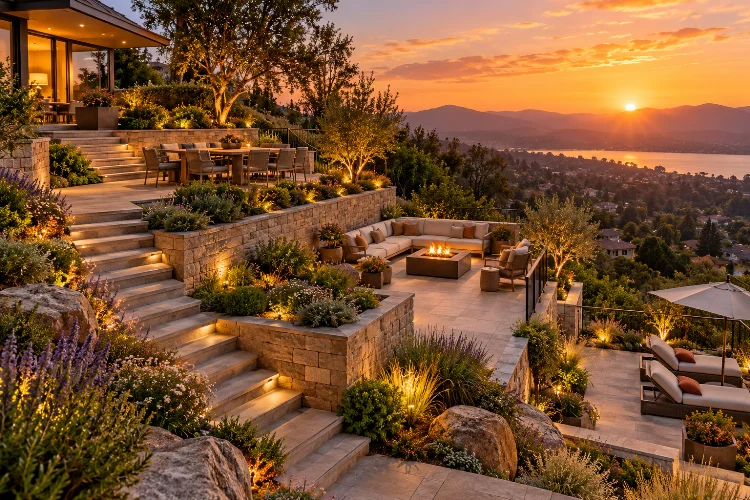
One level might handle dining, another can become a lounge or fire-pit area, while planted terraces connect the hardscape to the surrounding garden.
Terracing is also useful for managing steep ground. Iowa State University Extension notes that retaining materials can create flatter planting zones while slowing runoff and helping address erosion on hillsides.
The strongest designs do more than create flat surfaces. They coordinate drainage, circulation, views, retaining structures, furniture, and planting so every level feels like part of one landscape.
Start With the Existing Grade
Before deciding how many patio levels you want, understand the slope you already have.
Measure the elevation difference between the house and the lower parts of the garden. A gentle slope may need only one small step between terraces, while a steep site could require several distinct levels.
Also watch how water moves.
Slopes become increasingly difficult to walk, irrigate, and maintain as their gradient increases, and runoff can move downhill before it has time to soak into the soil.
Mark areas where water collects, soil washes away, or downspouts discharge onto the slope.
This information should influence the patio layout before retaining walls or paving are positioned.
A professional site survey can be especially useful on complicated properties because relatively small elevation errors on paper can become substantial construction problems across a large garden.
Give Every Patio Level a Clear Purpose
Avoid creating terraces simply because the slope allows them.
Each level should earn its place.
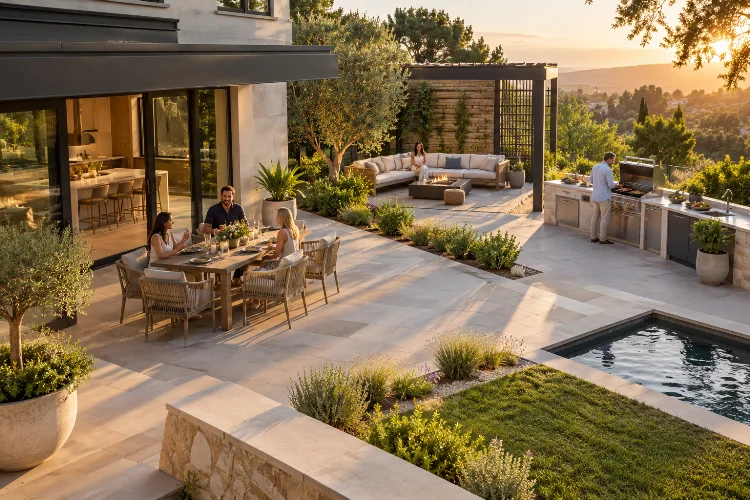
The level closest to the kitchen might become the main dining terrace because food needs to travel there frequently. A lower platform could accommodate a fire pit, conversation seating, or a quieter lounge.
A real-world sloped-yard redesign featured by Houzz used three tiers: an upper deck, a middle play area, and a lower patio with a fire pit. The project demonstrates how elevation changes can separate activities while keeping the landscape connected.
Think about frequency of use.
Daily activities should generally be easier to reach than occasional ones. Nobody wants to carry breakfast down twenty steps every morning just because the upper terrace was given to an ornamental feature.
Well-planned levels create natural zoning without requiring tall screens or fences.
Keep Retaining Walls Proportional
Retaining walls often make multi-level patios possible, but they can easily dominate the landscape.
One very tall wall may create the maximum amount of flat ground, yet several lower terraces can sometimes feel more comfortable and integrated.
Retaining walls are structural elements designed to resist pressure from soil and water while supporting changes in grade. They can also create level ground and help control erosion.
Material matters visually.
Natural stone may work beautifully with an informal garden, while concrete or large-format masonry can complement contemporary architecture. Brick can connect a patio to an older house when the colors and proportions are carefully considered.
Do not treat substantial retaining walls as decorative DIY edging.
Foundation requirements, soil conditions, drainage, reinforcement, wall height, and local building rules can all affect structural design. For significant walls, professional engineering or specialist landscape input is worth considering.
The wall should support the landscape rather than become the only thing anyone notices.
Design Drainage Before the Paving
Water does not disappear because the slope has been converted into patios.
In fact, hard surfaces can concentrate runoff if the drainage system has not been designed correctly.
Retaining walls need particular attention because water accumulating behind them increases pressure. Properly constructed systems often use free-draining material and drainage pipes to move water away rather than allowing it to build up behind the structure.
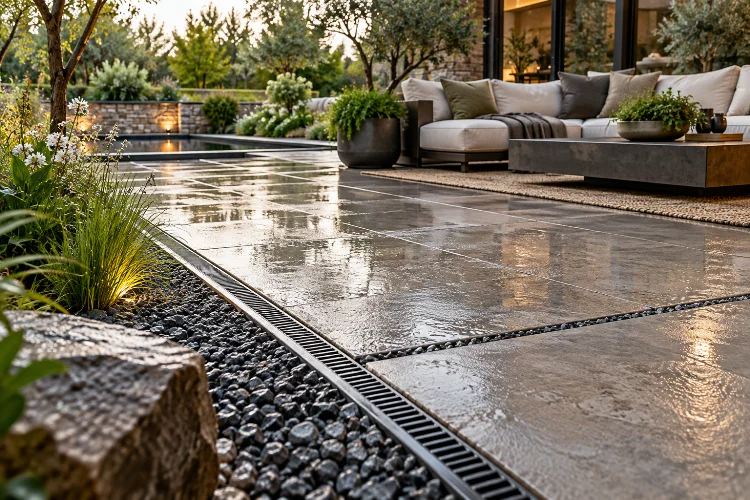
Patio surfaces also need appropriate falls or drainage channels.
Where site conditions allow, permeable paving may form part of the strategy. EPA guidance explains that permeable pavement allows rainfall to pass into a gravel storage layer beneath the surface, where water may then infiltrate into the native soil.
Do not make every terrace drain onto the one below it without a plan.
That approach can create erosion, staining, slippery surfaces, and excessive water around lower retaining structures.
Drainage should be considered one connected system from the highest part of the property to the final safe discharge or infiltration area.
Make Movement Between Levels Comfortable
A multi-level patio succeeds only if people actually want to move between the different areas.
Steps should therefore feel like part of the design rather than emergency connections inserted after the terraces are finished.
The most frequently used route should be relatively direct.
If the dining terrace sits below the kitchen, avoid forcing people carrying food to navigate a long ornamental staircase. More scenic paths can connect secondary areas where slower movement is appropriate.
Landings can become useful transistion spaces.
A wide landing may contain a planter, bench, or view across the garden. Changing the direction of a staircase can also reduce the feeling of one long descent.
Lighting is essential around changes in level.
Step lights, low-level path lighting, and subtle illumination around retaining edges can make elevation differences much easier to understand after dark.
Also consider whether an alternative gentler route is possible for wheelbarrows, garden equipment, strollers, or people who find stairs difficult.
Good circluation becomes increasingly important as the number of levels grows.
Use Planting to Soften the Hardscape
Terraces can easily produce a landscape dominated by stone, concrete, and walls.
Planting prevents the garden from feeling like an outdoor staircase.
Leave generous beds around retaining structures where space allows. Cascading plants can soften wall edges, while grasses and shrubs create transitions between terraces.
Iowa State University Extension recommends layered hillside planting because trees, shrubs, perennials, and groundcovers can help protect soil and reduce erosion more effectively than leaving exposed ground.
Plant conditions may change between levels.
Upper terraces can be warmer, windier, and drier, while lower zones may collect more moisture. Retaining walls can also create local microclimates by reflecting heat or producing shade.
Choose plants according to those differences rather than repeating exactly the same species everywhere.
Still, repeat a few key plants throughout the garden. That repetition visually connects each terrace and prevents the levels from feeling like completely seperate projects.
Use Elevation to Improve Views
Changing levels is not only a practical solution. It can create more interesting sightlines.
An upper dining terrace might overlook a lower planting garden. From the lounge below, the retaining wall and planting around the dining area could create a more intimate enclosure.
Think about what each level sees.
Place important focal points where they can be appreciated from several elevations. A multi-stem tree, sculpture, water feature, or large planting composition can visually connect different outdoor rooms.
Partial concealment is useful too.
Someone on the upper terrace does not necessarily need to see every chair on the lower patio. Small trees, grasses, or retaining-wall planting can create enough privacy while still maintaining a sense of connection.
Elevation naturally provides depth.
Use it to produce layered foreground, middle-ground, and background views rather than trying to make every terrace completely visible at once.
Size Each Level Around Real Furniture
A patio level is not useful merely because it is flat.
It also needs enough space for its intended furniture and movement.
Measure dining tables with chairs pulled out, not pushed underneath. Lounge seating needs room for people to walk around it, and a fire feature needs appropriate clearance according to its design and local safety requirements.
Temporary mockups are extremely helpful.
Use outdoor chairs, cardboard, string, or marking paint to represent furniture before retaining walls and paving make the dimensions permanent.
Remember that a terrace can be too large as well as too small.
Excess paving increases construction cost and can make a garden feel hard and exposed. Several appropriately sized outdoor rooms often work better on a slope than one enormous platform.
The goal is to create enough usable ground without unnecessarily rebuilding the entire hillside.
Keep Materials Consistent Across Levels
Multiple terraces already create strong visual variation.
Using a completely different material on every level can make the garden feel fragmented.
Instead, establish a limited material palette.
The same paving might appear on the upper and lower patios, while a complementary gravel or stone is used for secondary routes. Retaining walls can repeat materials or colors found in the house.
Subtle differences can still help define functions.
A lounge terrace might use the same paver in a different laying direction, while planting or furniture distinguishes it from the dining area.
Consistency becomes especially valuable when several retaining walls, staircases, and platforms are visible at the same time.
Repeating materials allows the changes in elevation to provide the drama without adding unnecessary visual clutter.
This creates stronger continunity from the house through the entire garden.
Plan Maintenance Access From Day One
Multi-level gardens can become annoying if every maintenance task requires carrying equipment up and down stairs.
Consider access for wheelbarrows, waste bins, gardening tools, furniture, and future construction.
Planting beds should also remain reachable for pruning, watering, and replacement.
Slopes themselves often require more thoughtful maintenance because steep ground can be difficult to access and irrigate. Iowa State University Extension recommends using plants suited to the site and favoring lower-maintenance species where hillside access is difficult.
Drainage systems need inspection too.
Leaves and sediment can block channels or drains, while permeable surfaces may require periodic maintenance to preserve their infiltration performance.
Think ten years ahead.
The most successful multi-level patio is not simply impressive immediately after construction. It remains practical once plants mature, furniture changes, and routine maintenance becomes part of everyday life.
Designing multi-level patios for sloped residential gardens turns elevation from an obstacle into a useful design tool.
The strongest layouts create purposeful terraces, comfortable circulation, properly engineered retaining structures, coordinated drainage, layered planting, and attractive views between levels. They flatten only the parts of the landscape that genuinely need to be flat.
Start by understanding the existing grade and water movement, then decide which activities deserve the easiest access. From there, build each level around realistic furniture dimensions and connect everything with consistent materials and planting.
Before major excavation begins, have retaining structures and drainage reviewed by appropriate professionals. Thoughtful planning can transform a difficult hillside into a series of outdoor spaces that feel naturally connected.