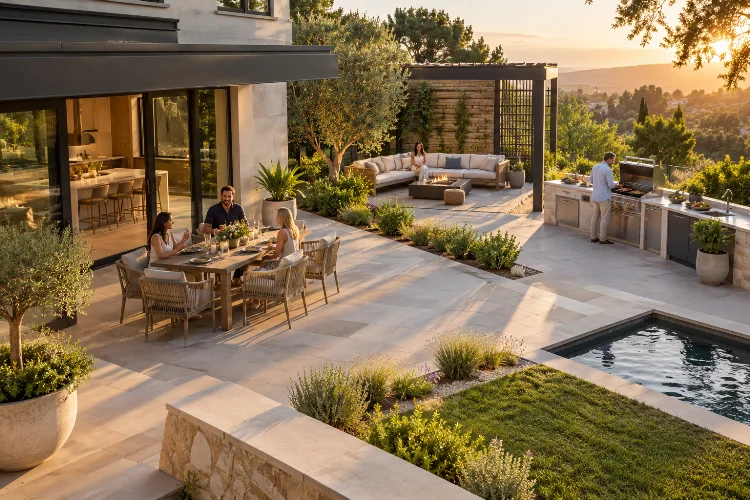
A patio material can look perfect in a showroom and become a completely different experience after a few years outdoors. Rain, intense sunlight, soil movement, stains, foot traffic, furniture, and seasonal temperature changes all influence how that surface performs.
That is why choosing patio materials for durability, drainage, and visual balance requires more than selecting your favorite color or stone pattern.
Concrete, natural stone, clay pavers, porcelain, gravel, and permeable paving systems can all create excellent patios, but each comes with different installation requirements and long-term characteristics.
The best option depends on climate, site drainage, intended use, maintenance expectations, and how the patio relates visually to the house and garden.
Drainage deserves particular attention. The RHS notes that non-porous hard landscaping can substantially increase rainwater runoff compared with garden surfaces that allow water to soak into the soil.
A successful patio therefore needs to look good on day one while continuing to work well after years of weather and everyday use.
Start With Performance Before Appearance
Color and texture matter, but performance should come first.
Ask how the patio will actually be used. A quiet seating terrace has different requirements from an outdoor kitchen, poolside patio, or busy family entertaining space.
Think about furniture loads, food stains, wet conditions, direct sun, children, pets, and seasonal weather.
Material properties also vary significantly within the same category. One natural stone may perform well outdoors in a particular climate while another variety can absorb more moisture or struggle with repeated freeze-thaw cycles.
The Natural Stone Institute tests stone for characteristics including water absorption, abrasion resistance, slip resistance, compressive strength, and freeze-thaw durability.
That means choosing “natural stone” is not specific enough.
Ask suppliers for technical information about the exact product you are considering, especially if the patio experiences frost, regular rainfall, or heavy use.
Durabilty comes from selecting the right product and installing it correctly.
Compare Concrete, Pavers, Stone, and Porcelain Realistically
Every patio material has trade-offs.
Poured concrete creates a relatively continuous surface and can support contemporary architecture particularly well. It can also be colored, textured, or divided into sections to add visual interest.
Concrete pavers provide more individual units and design flexibility. If damage occurs, individual pieces may sometimes be replaced without rebuilding an entire slab.
Clay paving offers another established option. Standards for pedestrian clay pavers include requirements relating to physical properties, dimensional tolerances, defects, and durability.
Natural stone provides genuine variation in color, texture, and pattern, but different stone types require different levels of maintenance and weather suitability.
Outdoor porcelain has become another option for contemporary patios.
Products specifically manufactured for exterior applications can offer low water absorption and resistance to staining and frost, although homeowners should check specifications for the exact product rather than assuming every porcelain tile is suitable outdoors.
There is no universal winner.
The best material is the one whose properties match the site, climate, design, and maintenance expectations.
Make Drainage Part of the Material Decision
A patio should never be designed as though rainwater disappears.
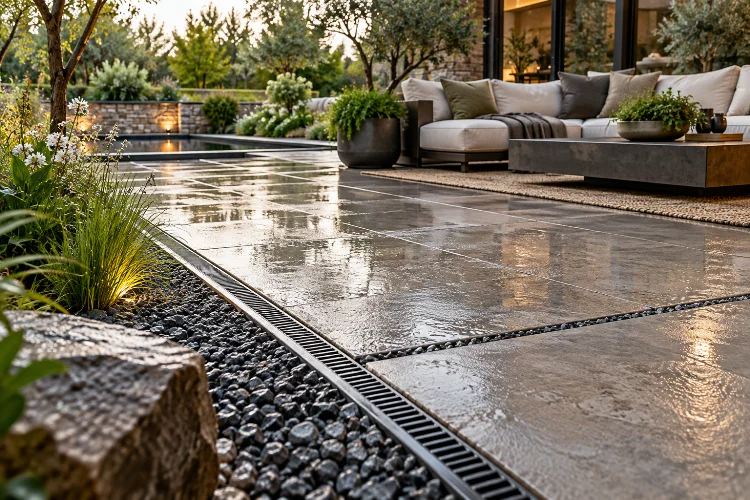
Conventional hard surfaces generally need appropriate falls, drainage channels, or another method for moving water away from buildings and preventing standing water.
For concrete slabs, a gradual slope is commonly used so runoff moves in the intended direction rather than collecting in low points.
Concrete Network describes roughly a 2% fall as a common rule of thumb for exterior concrete, although exact requirements should follow local conditions, codes, and professional recommendations.
Permeable surfaces work differently.
EPA guidance explains that permeable pavement systems allow stormwater to move through the surface into layers of gravel and soil below, where it may infiltrate naturally or move through an underdrain.
Options can include permeable interlocking pavers, porous concrete, or gravel-based systems.
However, simply purchasing a permeable-looking product does not guarantee good drainange. The base construction must also allow water to move through the system.
Drainage should therefore be designed together with the material, sub-base, surrounding landscape, and overall grading.
Consider Slip Resistance and Surface Texture
A highly polished surface may look impressive when dry and become frustrating after rain.
Slip resistance is especially important around pools, outdoor kitchens, steps, and uncovered patios.
Texture influences both traction and appearance.
Riven stone can produce a natural, informal character, while smoother large-format surfaces create a more contemporary aesthetic. However, overly rough materials may be more difficult to clean or move furniture across.
Natural Stone Institute guidance emphasizes evaluating appropriate slip-resistance standards for flooring and paving rather than assuming that every stone surface performs identically.
The same caution applies to porcelain and manufactured paving.
Look for exterior-rated products with appropriate technical testing for the intended application. Do not choose indoor tile for an outdoor patio simply because the finish looks similar.
If possible, obtain a sample and test it wet.
Walk across it, move a chair over it, and see how the texture feels underfoot.
Small samples can reveal practical issues that glossy catalog images rarely show.
Balance Hardscape With Drainage and Planting
Covering every available outdoor area with paving can make a garden easier to furnish, but it may create other problems.
The RHS states that non-permeable hard landscaping can increase rainwater runoff by as much as 50%, while permeable paving and retained planting areas can allow more water to enter the ground.
That makes the ratio between paving and planting important.
Instead of extending one enormous patio across the entire garden, consider whether every part needs a hard surface.
Planting beds can break up paving, improve visual softness, and provide places for rainwater to interact with the landscape. Gravel strips or permeable sections may also create functional transitions between hard surfaces and planting.
EPA similarly identifies permeable pavement as a green-infrastructure technique that can store or infiltrate rainfall where it lands.
The patio should therefore be considered part of the wider landscape drainage system rather than a completely isolated platform.
Match Materials to the House Without Copying Everything
Visual balance does not mean matching the patio exactly to the building.
In fact, using identical colors everywhere can sometimes make the exterior feel flat.
Instead, look for relationships.
A warm brick house might work with neutral stone containing similar undertones. A modern home with dark window frames could use pale paving for contrast while repeating darker details through furniture or edging.
The RHS recommends testing paving samples alongside existing house and garden materials and considering how colors transition between indoor and outdoor areas.
This is particularly helpful because materials often look different outdoors than they do under showroom lighting.
Place samples in the actual garden for several days.
Look at them in morning sun, shade, wet weather, and evening light. Also compare them with exterior walls, doors, boundary materials, planting, and furniture.
Try to limit the number of dominant hardscape materials.
One primary paving material supported by a secondary edging, gravel, or contrasting detail will often feel calmer than five unrelated surfaces competing for attention.
Use Pattern and Scale to Control Visual Weight
Material choice is only half of the visual equation.
Unit size and laying pattern can dramatically change how a patio feels.
Large-format slabs can create a calm, contemporary appearance because there are fewer joints. Smaller pavers may introduce more texture and suit traditional, detailed, or irregular layouts.
RHS educational guidance identifies color, pattern, proportion, installation, and maintanance as important considerations when selecting paving for patios.
Think about the scale of the property too.
Oversized slabs in a tiny courtyard may require many awkward cuts, while very small units across an enormous terrace can become visually busy.
Patterns can also establish zones.
A subtle change in paving direction might distinguish an outdoor dining area from a lounge while keeping the same material throughout.
That is often more cohesive than using a completely seperate surface for every activity.
Visual structure usually becomes stronger when variation is controlled.
Think About Maintenance Before You Commit
Every outdoor surface requires some level of care.
The question is how much maintenance fits your lifestyle.
Concrete may need periodic cleaning and, depending on the finish and sealing system, occasional resealing. Concrete Network notes that many patio sealers typically last several years before reapplication becomes necessary, although actual intervals depend on the product and exposure.
Natural stone may require cleaning or sealing depending on the variety and finish.
Paver joints can collect weeds or debris if they are not properly installed and maintained. Gravel is permeable and visually flexible but can migrate and may require occasional leveling.
Porcelain designed for exterior use is often marketed as a lower-maintenance option because of its low absorption, but installation quality and correct product selection remain essential.
Do not compare only installation prices.
Consider maintenance over ten or fifteen years, including cleaning, sealing, joint repairs, replacement pieces, and possible drainage maintenance.
A slightly more expensive material may make sense if it better matches how much ongoing work you realistically want to do.
Choosing patio materials for durability, drainage, and visual balance is ultimately about matching the surface to both the property and the way people will use it.
Evaluate weather exposure, drainage, slip resistance, maintenance, color, texture, and installation requirements before committing to a material. Compare exact products rather than relying on broad labels such as stone, concrete, or porcelain.
Then test samples in the real landscape and consider how the patio connects with planting, architecture, and other hardscape.
Before construction begins, make drainage part of the design rather than an afterthought. A well-chosen patio should not simply photograph beautifully – it should remain comfortable, practical, and visually connected to the garden for many years.